PROJECTS
Full project notes, essays, and strategy work.
The homepage stays as the quick portfolio overview. This page holds the longer reads and project detail for anyone who wants to go deeper.
FULL ESSAY
Swoop: How does a growing travel brand stay ahead?
A full academic essay examining how Swoop’s management practices align with, adapt, and challenge small-business theory.
To what extent do management practices in a small or family business align with, adapt, or challenge what academic theory covered on this module suggests?
Asking whether a small business aligns with, or challenges management theory is a tougher question than whether the theory is useful. Alignment means practicing the theory, adaptation means using the theory but reshaping to fit their particular case. To challenge the theory means there is a gap between the theory and what the real business has to practice. A single case study provides a productive lens for the question, because it provides direct evidence that a survey cannot and forces direct comparisons between models and specific circumstances.
The company focused on Swoop is a non-family SME operating in tourism, founded in 2010 and specialising in trips to Patagonia and recently expanding to Antarctica. With approximately 100 employees, operating as an agent. With the core values being in knowledge, trust in relationships and itinerary design rather than physical infrastructure of the travel. Luke the founder and now CEO, provided me with an interview on which this essay will quote. He began the business after falling in love with Patagonia on a holiday, spending time at companies at Bain and Booking.com, before founding Swoop and securing its first booking on ‘18 October 2010.’
This essay draws on three themes from the interview. The first addresses Luke’s journey from doing everything himself to actively removing himself from operational decisions. The second focuses on the structural and communicative tensions as Swoop has grown. The third concerns the business’s response to AI and disintermediation. Across these three themes, Swoop’s practices largely align with established SME growth theory, partially adapt it where the business occupies an awkward middle ground between startup and corporation, and in one significant area. The threat of AI disintermediation moves into territory that existing theory does not yet adequately address.
Theme 1: The Founder’s Journey
Scholars argue that organisations grow through predictable phases (Greiner, 1972), each ending in a crisis that shifts how the business is managed. The earliest of these is the crisis of leadership, the founding entrepreneur, who has built the business through personal commitment and direct involvement, eventually reaches a point where informal control becomes a ceiling on growth. Sharing power is no longer an option. Scott and Bruce (1987) offer a five-stage model where the founder’s role must evolve from hands-on operator to strategic leader as the firm matures. Churchill and Lewis (1983) provide a third framework, identifying the owner’s ability to delegate responsibility as a significant variable as to whether a business moves successfully from survival through its growth. All three models share the same prediction: failure to delegate is a primary cause of stalled growth, and the transition is uncomfortable. Lumpkin and Dess (1996) on entrepreneurial orientation offer a similar lens, useful for understanding what persists in the founder’s role even after operational control has been relinquished.
Luke’s account of his own development maps onto all three frameworks. He describes the early stages of the business: “There’s a sort of sense of omniscience and omnipotence because everyone needs you… it’s very ego-flattering because you do know everything, and you control everything. But it’s kind of flawed at the same time.” From that point, he traces an arc, from doing everything himself, then to controlling everything whilst others executed, then gradually withdrawing from specific decision areas as new senior roles were filled. At the time of the interview, he is no longer involved in hiring below management level, anything sub £10,000, or in setting targets for the sales team. Each transition was triggered by the arrival of a new senior hire, a marketing manager, then an HR manager, then a COO, each of which absorbed a role Luke had previously done himself. His current role is concentrated on vision, strategic direction and culture. One area where his involvement remains conspicuously personal is the company get-together. This year in Scotland, where the team hike together, plant trees and spend time together as it is a virtual company spread across 11 countries. He is involved in this in ways he is not involved in other parts of the company.
In terms of alignment, this broadly supports all three frameworks. The delegation crises that the scholars previously mentioned have appeared to play out in Swoop in roughly the anticipated sequence. Luke describing omniscience as ego-flattering but unsustainable maps closely onto the transition the models describe. The general arc, from founder as operator, to founder as controller, to founder as strategic leader, maps clearly onto what the literature anticipates.
In terms of adapting the theory, Luke’s account complicates the stage model in one important respect. His role did not shift at crisis points, it shifted incrementally, each time a new hire arriving and absorbing a function he previously performed. The stage model presents growth as punctuated phases. Luke’s experience suggests more like a continuous renegotiation of his identity, in which the question of what he should or shouldn’t do is never resolved but constantly revisited.
Lumpkin and Dess (1996) help account for this. Even as control is relinquished, Luke’s continued investment in the culture and team bonding of the company suggests that his identity as an entrepreneur does not disappear as the business grows, it migrates. Luke’s case suggests it is more accurately a story of reallocation. Some dimensions of the founder’s role are genuinely shed, while others are retained precisely because they cannot be delegated without something essential being lost.
Theme 2: Communication, Structure, and the Challenge of Scale
Burns (2022, Chapter 13) addresses the internal management challenges of growing a small business, with attention to the tension between organic, people-focused culture and the requirements that scale imposes. Greiner’s crisis of control is directly applicable, the informal coordination that works at a smaller scale becomes insufficient and formal systems are introduced as a replacement, with these new systems having their own drawbacks. Bambenger (1989) adds that the very informality generating agility as a company can become a liability as numbers grow, making formalisation necessary. Stokes (2017) provides further grounding for the management challenges of running a business at this size, where the absence of corporate infrastructure makes every structural decision carry disproportionate weight.
Luke describes a company in which different teams operate under different structural logics at the same time. The customer service team for example follow rigid procedures. When asked whether this kills creativity, Luke is clear that it does. He cites conversations with the Chilean team whose ideas are not surfacing because of what he says is a “slight command and control structure.” The marketing team operates with more fluidity, with ideas from the bottom heard and acted on. The sales team “does anything to win a booking.” The development team works in two-week sprints, with tickets prioritised by a separate planning group and a retrospective after each sprint. The structural problem is made apparent by Luke’s description of his management chain. A message from Luke travels to COO, to sales director, to sales manager, and only finally to salesperson, four or five steps, which he describes as Chinese whispers. “What I share with the manager has gotta be sufficiently clear… that gets exponentially more difficult as each new layer comes in. It’s incredibly hard for me to convey to the person on the front line the messages that I would love customers to hear about a particular hiking route or what it’s like to stand in a penguin reverie.”
His response to this challenge is to hold a monthly company meeting in which he spends approximately a third of the time speaking about vision and purpose, supplemented by training. But he is sure these efforts are only partial solutions. At 100 people he says, the business is in an awkward middle ground: “If you’re a 1,000-person company, you’ve got the processes and the ways of working to make that happen. And if you’re a 20-person company, you don’t need it. At 100, it’s a real challenge.”
In terms of alignment, this aligns strongly with what Burns and Greiner state. The tension Luke describes between formalisation and flexibility is precisely the tension both theorists identify as characteristic of this growth stage. The discomfort with SOPs, the sense that procedures designed to guarantee consistency are suppressing the lateral thinking that creates an advantage, is a near-textbook illustration of Greiner’s crisis of control. Burns’ theory on the difficulty of maintaining entrepreneurial culture as the headcount grows is also applicable, with the Chinese whispers problem, the exponential difficulty of communicating meaning through the layers of management, mapping directly onto the communication challenges the literature associates with this phase of development.
In terms of what Swoop adapts, Swoop does not occupy a single structural position. It sustains multiple logics simultaneously, each calibrated to the particular demands of the function it governs. Customer service is mechanistic. Marketing is organic, sales is effectively unstructured. The firm is not transitioning from one structural logic to a different one, as stage models suggest. It holds several in parallel.
Existing frameworks tend to characterise firms as broadly formal or informal at a given stage of development. Burns and Greiner’s models are applied at the level of the firm. What Swoop’s case suggests is that the practical management response to scale may not be to choose a structural logic for the organisation as a whole, but to develop the capacity to hold different logics in productive tension across functions. This is an adaptive move that the literature gestures toward but does not fully theorise.
Theme 3: Adapting to Disruption, AI, Sustainability, and Strategic Response
Burns (2022, Chapter 13) addresses the pressures facing SMEs including the threat of losing market position to structural changes in the industry. Audretsch and Thurik (2001) provide broader context for understanding how digital disruption reshapes the competitive landscape for smaller firms, arguing that the shift toward a knowledge-based economy has made adaptability and information crucial. Carter and Jones-Evans (2012, Chapters 21 and 22) address competitive strategy and adaptation in small companies, with particular relevance to differentiation as a sustainable response. Together these frameworks provide a starting point for thinking about how an SME in a disrupted market should respond. As this section argues, only a starting point.
Luke identifies agentic AI as the single greatest threat to Swoop’s business model. His framing is precise and unsettling: “Agents - what makes a good agent is someone who’s got lots of knowledge, a great network, the ability to piece together a complex itinerary from lots of information, and then go off and make lots of reservations. And all those things I’ve just described are what agentic AI just swallows up.” The threat is structural, if AI can replicate Swoop’s knowledge base, design itineraries, compare operators, and make reservations directly, the customer has no need of the intermediary. The business’s entire value proposition could be bypassed.
His response to these issues takes place in three ways. First an investment in the brand, with the idea being that even if a customer turns to AI, the Swoop name should be more visible to the consumer. Secondly, a more focused transition into group tours to create a product that is not currently being replicated by competitors, because this product is unique to Swoop. Thirdly, an expansion plan looking at destinations of the Galapagos, the Arctic and then South Africa. Extending carefully however as not to dilute its presence and power. He is honest about his timeline, noting that their customer base is typically affluent Americans in their sixties, less likely to adopt AI. But he did then refer to the sobering parallel of online car sales, stating that fifteen years ago no one would have bought a car online.
Further, crucially in the modern age, is his commitment to sustainability. Swoop abandoned carbon offsetting after concluding that it was not making a meaningful enough difference. Swoop now invests 1% of its revenue, approximately £110,000, directly into conservation projects in Chile and Argentina. It is also proud of its status as a B Corp. Luke describes these decisions as driven by genuine belief rather than a wholly marketing standpoint.
However, Swoop challenges the theory as Burns and Audretsch provide framing for competitive threat and the importance of adaptation. The disintermediation concept is applicable, however there is very little literature on the threat of AI especially to knowledge-based intermediaries. A category of business whose competitive position rests on knowing more than the customer. AI does not merely increase competition but can also reduce transaction costs. It has the potential to eliminate the informational advantage that holds this business together.
Luke’s response is well thought out. Brand is their product and expanding geographically are ways of creating value harder for AI to replicate. But they arrived through experience more than any available theoretical framework. This is where the hardest challenge to the literature is visible. Existing SME theory has not yet caught up with AI as a force that can eliminate the informational advantage that Swoop possesses.
The sustainability dimension expands upon this. Carter and Jones-Evans on differentiation and values-driven competitive positioning provides the most applicable lens. Luke’s move away from offsetting functions as a form of brand differentiation. A signal of authenticity to the kind of customer who travels to Patagonia precisely because they care about what happens there. Theory can accommodate this even if it does not fully anticipate it. The more interesting point is that Luke’s engagement with sustainability is more critical and more sceptical than the CSR literature typically models: he is not adopting a CSR framework but rejecting one form of it and substituting a more direct relationship between the business and the places it depends on.
Conclusion
Taken together, the three themes support different accounts of how Swoop’s management practices relate to SME theory. However, there are areas that align, some that adapt, and some that challenge the theory.
The first theme broadly aligns with the frameworks offered by Greiner, Scott and Bruce, and Churchill and Lewis. The delegation crises these models predict have played out at Swoop as anticipated. Where the case study adapts what the models predict is the nature of the transition. Not a series of described phases but rather a continuous and incremental change driven by the arrival of senior hires. The persistence of entrepreneurial identity in the culture of Luke’s company and the annual get-togethers adds a dimension the stage models do not fully capture. Lumpkin and Dess help here, but their framework too does not account for the way the founder’s role reallocates rather than diminishes.
The second theme aligns with Burns, Greiner, and Bambenger on the formalisation-flexibility tension that growth generates. The issue of Chinese whispers, the difficulty of communicating meaningfully through the management layers, is a close read of the theory and what it anticipates at this stage of the company. But it challenges the framework by demonstrating that a company such as this can have different structural logics across different areas. Existing theory characterises firms as formal or informal. Swoop, however, is both depending on where you look.
The third theme is where the gap between theory and real evidence is most evident. The literature provides a starting point talking about competitive threat and the ever-growing importance of adaptation. But SME theory does not account for the dynamics of AI as a force. Luke’s response is strategic yet arrived through lived judgment rather than theoretical frameworks.
The broader lesson of this case study is that foundational SME theory helps to provide real explanatory power when used in the context of a business in a complex condition. The main frameworks illuminate what is happening to Swoop. But the best use of the theory is not to confirm the company is doing as predicted but rather to attend to the moments where practice diverges from prediction. These are the gaps where the theory has not caught up with the actual conditions SMEs operate in. At Swoop, the most obvious of those gaps concerns AI. Any small business whose competitive position rests on knowledge should be asking the same question that Swoop is asking, what happens when that knowledge can be replicated for free? The module frameworks help that question even if they cannot yet answer it.
# Bibliography
Audretsch, D.B. and Thurik, A.R. (2001) ‘What is new about the new economy: Sources of growth in the managed and entrepreneurial economies’, Industrial and Corporate Change, 10(1), pp. 267-315.
Bambenger, I. (1989) ‘Developing competitive advantage in small and medium-size firms’, Long Range Planning, 22(5), pp. 80-88.
Burns, P. (2022) Entrepreneurship and Small Business: Start-up, Growth and Maturity. 5th edn. London: Red Globe Press.
Carter, S. and Jones-Evans, D. (2012) Enterprise and Small Business: Principles, Practice and Policy. 3rd edn. Harlow: Pearson.
Churchill, N.C. and Lewis, V.L. (1983) ‘The five stages of small business growth’, Harvard Business Review, 61(3), pp. 30-50.
Greiner, L.E. (1972) ‘Evolution and revolution as organizations grow’, Harvard Business Review, 50(4), pp. 37-46.
Lumpkin, G.T. and Dess, G.G. (1996) ‘Clarifying the entrepreneurial orientation construct and linking it to performance’, Academy of Management Review, 21(1), pp. 135-172.
Scott, M. and Bruce, R. (1987) ‘Five stages of growth in small business’, Long Range Planning, 20(3), pp. 45-52.
Stokes, D. (2017) Small Business Management and Entrepreneurship. 7th edn. Andover: Cengage Learning.
FULL ESSAY
Deinfluencing and platform-based resistance
A full academic essay examining TikTok deinfluencing as both social justice critique and platform-capitalist content.
Deinfluencing and the Paradox of Platform-Based Capitalistic Resistance on Tik Tok.
Introduction
This essay examines TikTok’s deinfluencing as its primary study as it shows us a revealing example of how media is both an ally and an opponent to social justice. Emerging primarily in late 2023 onwards, deinfluencing has developed in response to living costs, climate issues and general dissatisfaction with influencer led overconsumption.
Over the past two years, TikTok has emerged as a central platform which is forefront of every aspect of our culture, whether that’s political or popular culture. This essay examines the TikTok deinfluencing trend (2023-2025) as a contemporary media event that is pretty much unseen, focusing on primarily on social justice issues relating to capitalism, gendered labour, class inequality, and environmental harm where in which creators publicly discourage consumption and critique influencer-led excess that comes from creating their content. Emerging in late 2023 and gaining prominence in response to economic pressure and growing dissatisfaction with online overconsumption, deinfluencing offers a timely case study for analysing how media can both enrich and compromise social justice efforts.
As this essay argues, deinfluencing can help but also distracts from efforts to amend injustice. While it exposes inequalities embedded within contemporary consumer culture, it also poses a huge risk of being used as a weapon and being absorbed into the very system it seeks to resist. By examining deinfluencing as a platform-based form of consumer resistance, this essay highlights the tensions between resisting and staying economically viable on social media.
Context & Literature Review
TikTok’s deinfluencing trend has emerged as a response to hyper-consumerism; however, scholars increasingly argue that such practices remain deeply embedded within the very infrastructures they seek to critique, revealing tensions between resistance and reproduction under capitalism (Lawson, 2024). This reflects broader scholarship suggesting that “influencer” culture is not driven by individual creators alone, but by an economy of visibility, aspiration, and monetisation. Abidin (2016) describes influencers as engaging in “aspirational labour”, in which authenticity becomes a strategic resource for building trust and visibility. Similarly, Duffy (2017) highlights how this search for justice is often unpaid or underpaid, making it often taxing and emotionally difficult.
Deinfluencing attempts to challenge the structures built in our capitalist society by rejecting sponsorships and exposing unethical market practices. However, as such critiques gain visibility, they often become forms of marketable authenticity themselves, reinforcing rather than dismantling influencer economies. This dynamic aligns with scholarship on popular feminism and media activism. Banet-Weiser (2018) argues that feminism increasingly circulates as a media identity, prioritising empowerment and authenticity over systemic critique. Mukherjee and Banet-Weiser (2012) describe the process as “commodity activism”, in which choices made by corporations and lawmakers are reframed through consumer choice. As deinfluencing frequently draws on feminist and ethical rhetoric surrounding sustainability and ethical beauty, yet rather than challenging the structural conditions that enable overconsumption, responsibility is often shifted onto the individual consumer, reproducing the same logic it seeks to critique.
The gendered nature of this dynamic is further highlighted by Gill (2016), who argues about how that contemporary media cultures encourage women to be entrepreneurial while framing success as the result of their own individual effort rather than change of the system itself. As a result, inequalities are obscured by presenting digital labour as voluntary or empowering. Resistance to the over consumption of capitalism, therefore, continues to rely on unequal and often invisible digital labour, limiting its potential for meaningful social change.
At a broader structural level, Srnicek (2017) argues that digital platforms are designed to extract value from all user activity, converting engagement into profit regardless of our intent or the content produced. This process is intensified by what Zuboff (2019) terms “surveillance capitalism,” in which human experience itself is transformed into data for behavioural prediction and monetisation. As a result, de-influencing content can generate advertising revenue and data extraction even when it explicitly critiques consumption, demonstrating how opposition is absorbed into platform logics.
Critical theory further illuminates this contradiction. Lessenich (2019) describes capitalism as an “externalisation society,” reliant on shifting social and environmental costs elsewhere. De-influencing momentarily exposes these hidden harms by drawing attention to exploitation, waste, and environmental damage. However, Adorno (2005) warns that the culture industry has the capacity to transform resistance into another aestheticized commodity. This insight resonates strongly with de-influencing’s evolution into a recognisable and repeatable content genre. Finally, Rosa (2015) argues about how social acceleration and competitive pressures drive both consumption and anti-consumption movements within the mixed-forms of contemporary media. Taken together, this scholar’s position frames deinfluencing as a contradictory phenomenon that simultaneously challenges and reproduces capitalist structures, making it a valuable case study for analysing how media can both enrich and compromise social justice efforts.
How TikTok Deinfluencing Enriches Social Justice
The movement of deinfluencing trends that have hidden harms initially enriches social justice. Drawing on critical theory, this section argues how deinfluencing unjust capitalistic trends creates moments of awareness, education and resistance within our modern-day culture that is so social media-focused, even if these moments are fragile and short.
Using Lessenich’s thoughts on the externalisation of society, deinfluencing helps to uncover how our prosperity as a capitalist society depends on shifting social and environmental costs to the less fortunate, as “the good life here is systematically connected to the bad life elsewhere” (Lessenich, 2019, p. 4). Such as the popular movement in the last few years of de-influencing brands such as Shien and quick-beauty products, drawing attention to wasteful consumption and the destructive supply chains of beauty brands in general. By exposing these issues, deinfluencing reframes consumption as an issue with the structure rather than the fault of the consumer. Deinfluencing also operates as a critique of Adorno’s (2005) concept of the culture industry, which creates desire and conformity through mass-produced culture. Adorno (1991, p. 139) states, “the culture industry perpetually cheats its consumers of what it perpetually promises,” intimating how traditionally influencers promise authenticity and quality, whilst often delivering dissatisfaction. Deinfluencing can disrupt this logic by discouraging purchases such as the ‘anti-haul’ movement as a result of the ‘try on hauls’ by influencers. Normalising purchasing an obscene amount of fast fashion, a form of paid media from major retailers, to encourage a similar mindset in their consumers. The movement inverted haul culture, encouraging consumers to reflect on how their desires are often manufactured rather than fulfilled.
Through Rosa’s theory of the constant state of social acceleration. Deinfluencing can be thought of as a response to the increased pressure to keep up with trends and upgrades. Arguing that modern capitalism involves “dynamic stabilisation, meaning that society must constantly grow, innovate, and accelerate simply to remain stable” (Rosa, 2015, p. 109). Deinfluencing content promotes slowing down, reusing products that don’t need to be changed and opting out of trend cycles. For instance, creators are encouraging consumers to stop prescribing in technology releases such as Apple. With a new model of phone coming out annually and constant minorly changed new versions of secondary products, influencers encourage consumers to use wired headphones and to attempt not to envy the new products that are not needed. These moments have aligned with what Rosa described as “resonance,” interrupting the constant acceleration and instead producing a feeling of appreciation.
“Promises fulfilment but rarely delivers stability” (Duffy, 2017, p. 7) and similarly, Abidin (2016) shows influencers are expected to be authentic while remaining commercially viable. In recent years, many deinfluencing creators have talked about how it’s difficult to obtain brand deals and stay viable within the algorithm, particularly within beauty and lifestyle sectors, which are dominated by women. Videos discussing sponsorship fatigue or rejecting brand deals show the difficulty and painful process of remaining visible on social media, showing the difficulty in creating space for ethical critique and marginalized voices. Finally, deinfluencing intersects with academic sources on popular feminism and commodity activism. Banet-Weiser (2018) argues that empowerment increasingly is used as a branded identity for influencers and companies alike, where “politics becomes a matter of market choice rather than collective struggle.” Deinfluencing can partially counteract this trend by highlighting ethical issues. For example, creators from marginalized backgrounds have used deinfluencing to challenge Caucasian central beauty standards, critique overconsumption within luxury beauty culture, and question why ethical consumption isn’t accessible to everyone seeming to cost far too much for most to afford.
Overall, deinfluencing enriches social justice by revealing the hidden challenges, challenging consumer compulsion, and creating moments of critical reflection within accelerated platform culture. However, as the following section will demonstrate, these moments of resistance do often quickly burn out and are easily absorbed back into the systems they seek to question.
How Deinfluencing Compromises Social Justice
While deinfluencing may imply resisting consumer capitalism, this section argues that it is absorbed into the system it attempts to break down. Critiquing is transformed into content; resistance turns into performance, and ethics into a new aesthetic to market.
Deinfluencing can exemplify how resistance is enveloped within the culture industry. Even the oppositional culture is reused as a consumable form, such that “the culture industry absorbs the resistance it provokes” Adorno, 1991, p. 158). This observation highlights the inherent challenge of genuine resistance within our capitalist system. As the quote suggests, attempts to challenge the status quo can end up repurposed, thereby diluting the impact of the original goal. This dynamic accentuates the complexity of achieving social change in a media plane that thrives on consumption and novelty.
This process is intensified by platform capitalism. Srnicek (2017) argues that platforms are curated to create value from user activity, with content changed to increase engagement and data extracted rather than impact. Deinfluencing content, regardless of its ethical message, generates views and advertising value. As Srnicek notes, “position themselves as intermediaries while extracting data as a source of competitive advantage” (Srnicek, 2017, p. 43). Showing how platforms like TikTok present themselves as neutral bystanders, but in reality, use our data to gain an edge. Showing why the US government did not like TikTok being used in the States, as a different government had access to such crucial data. Meaning content on these platforms that aim to challenge capitalism is ultimately turned into data that benefits the platform’s motives. Zuboff (2019) talks about ‘surveillance capitalism’ too, also stating how our human experience is being turned to profit. As such, influencers must survive algorithmically, adopting what performs well, encouraging self-discipling behaviour, where critique can be softened or repeated to maintain reach, limiting the amount of change this content can actually create. Such as during the Gaza conflict, where influencers focused greater on humanitarian efforts and peace than on diving into military action. This led to a more surface-level portrayal, helping them to stay in the platform’s good books and earn monetization. Showing the issue with the platforms and how the need to earn revenue has shaped narratives incorrectly.
Deinfluencing often frames systematic problems as our fault; the consumer is out of our choice. It can be stated how activism “privileges consumption as the primary site of political engagement” (Mukherjee and Banet-Weiser, 2012, p. 9). Encouraging viewers to ‘buy better’ but rarely addressing structural drivers such as corporate legislation, lobbying or environmental policy. Consequently, responsibility is placed on individuals like the gun violence crisis in America, where we have seen a rise of criticism of those who own firearms, rarely talking about the decisive reason, the culture and the lobbying of the major gun companies that constantly block any law changes, meaning industrial power remains often unchallenged.
Finally, deinfluencing does not escape the inequalities that are too deeply embedded in our economy. Duffy (2017) highlights how initially digital activism relies on unpaid work, which can be particularly negative for women, due to the industries they dominate in the media. Similarly, Gill (2016) ties into this showing how postfeminist media cultures demand constant self-optimization and visibility. Deinfluencing creators, especially those without existing popular platforms or current economic safety, must continue producing content to remain relevant, undermining the possibility of keeping up their resistance. In this way, critique becomes another form of a need to earn capital rather than a political standpoint.
All in all, deinfluencing compromises social justice by transforming critique into content, individualising responsibility, and reinforcing the exploitative logics of platform capitalism. It ultimately illustrates Adorno’s warning that within capitalist media systems, opposition is rarely abolished but more often repackaged, circulated, and sold, keeping the cycle in place.
Social Justice Implications
Overall, the case of social media deinfluencing demonstrates how digital platforms can momentarily enrich social justice by exposing exploitation, drawing attention to wasteful cycles, and unethical practices. Further, it challenges the culture industry for perpetual novelty, questioning why we as consumers feel compelled to constantly upgrade products. Through Adorno’s perspective, this interruption is important as it promotes reflection rather than automatic participation in the constant new product cycle. In addition to this, Rosa’s analysis of social acceleration helps explain why consumers experience exhaustion, guilt and anxiety in competitive, relentless consumer cultures. But encouraging us to pause, de-influencing gives us space to evaluate what is important. Such as the “use what you already own” trend resonating with users experiencing financial strain during the rising cost of living.
However, the effectiveness is sharply limited by the structural conditions of platform capitalism. While deinfluencing critiques our consumerism, it remains dependent on the same infrastructure that monetises our attention. Such as the overconsumption of the beauty industry, initially promoting not prescribing to the overconsumption, but later shifting towards “better consumption.” After a short amount of time, recommend different products framed as ethical or sustainable, paired with links to the product page. Illustrating the way resistance eventually becomes content.
Conclusion
This essay has argued that TikTok deinfluencing shows the paradox of the role of contemporary media in relation to social justice. It can both expose and reproduce the very systems it seeks to challenge. Drawing on key scholars such as Lessenich, Adorno, and Rosa, the academic research piece has shown that deinfluencing briefly disrupts consumer capitalism by making visible the processes of externalisation, commodification, and acceleration that underpin everyday consumption. In doing so, it offers moments of discussion.
However, these moments of critique remain viability-limited. As Adorno’s theory predicts, resistance is too often sold as a new way to create capital. Deinfluencing rapidly becomes a genre dictated by social media’s logic, where refusal itself generates value. Rosa’s account of social acceleration further explains why such a critique cannot easily be sustained; creators and audiences alike remain locked into cycles of competition. Critique is transformed into data, engagement, and monetizable labour.
Ultimately, deinfluencing demonstrates that media activism can help social justice by raising awareness and challenging dominant narratives, but it cannot substitute for structural political change. By individualising responsibility and privileging ethical consumption over collective action, it de-influences risks, creating more inequality. While digital platforms may amplify critique, they simultaneously constrain its transformative potential. Social justice, this essay concludes, cannot be achieved through purely consumer resistance alone on social media.
Bibliography
Abidin, C. (2016) ‘“Aren’t these just young, rich women doing vain things online?”: Influencer selfies as subversive frivolity’, Social Media + Society, 2(2), pp. 1-17.
Adorno, T.W. (2005) Minima Moralia: Reflections from Damaged Life. London: Verso.
Adorno, T.W. (1991) The Culture Industry: Selected Essays on Mass Culture. London: Routledge.
Banet-Weiser, S. (2018) Empowered: Popular Feminism and Popular Misogyny. Durham: Duke University Press.
Duffy, B.E. (2017) Not Getting Paid to Do What You Love: Gender, Social Media, and Aspirational Work. New Haven: Yale University Press.
Gill, R. (2016) ‘Postfeminism and the new cultural life of feminism’, Diffractions, 6, pp. 17-36.
Lawson, S. (2024) ‘Deinfluencing and the logics of anti-consumption on TikTok’, Journal of Digital Consumer Culture.
Lessenich, S. (2019) Living Well at Others’ Expense: The Hidden Costs of Western Prosperity. Cambridge: Polity Press.
Mukherjee, R. and Banet-Weiser, S. (2012) Commodity Activism: Cultural Resistance in Neoliberal Times. New York: New York University Press.
Rosa, H. (2015) Social Acceleration: A New Theory of Modernity. New York: Columbia University Press.
Rosa, H. (2016) The Uncontrollability of the World. Cambridge: Polity Press.
Rosa, H. (2019) Resonance: A Sociology of Our Relationship to the World. Cambridge: Polity Press.
Srnicek, N. (2017) Platform Capitalism. Cambridge: Polity Press.
Zuboff, S. (2019) The Age of Surveillance Capitalism: The Fight for a Human Future at the New Frontier of Power. London: Profile Books.
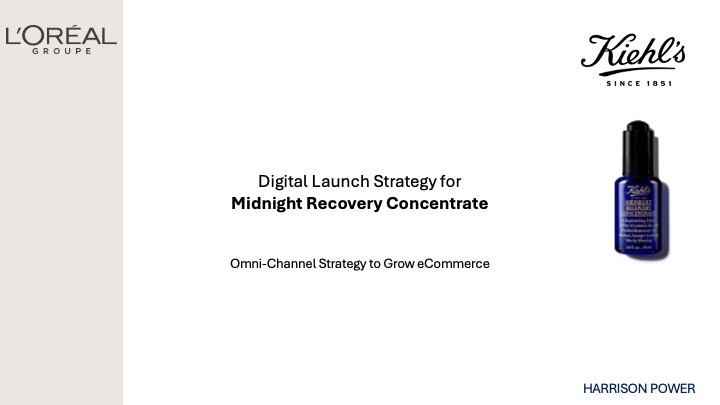
Kiehl’s Rebrand Concept
A deck-led brand strategy and digital launch concept exploring how Kiehl’s could keep its apothecary credibility while showing up with more warmth, clarity, and digital fluency.